It feels like Alex Eala checks off another milestone for Filipino tennis every time she takes the court.
The 21-year-old is the first player from the Philippines to capture a junior major title, defeat a top-10 opponent, and reach a WTA 1000 semifinal.
At Wimbledon, Eala upset defending champion Iga Swiatek to become the first Filipino in the Open era to reach the second week of singles play at a Grand Slam.
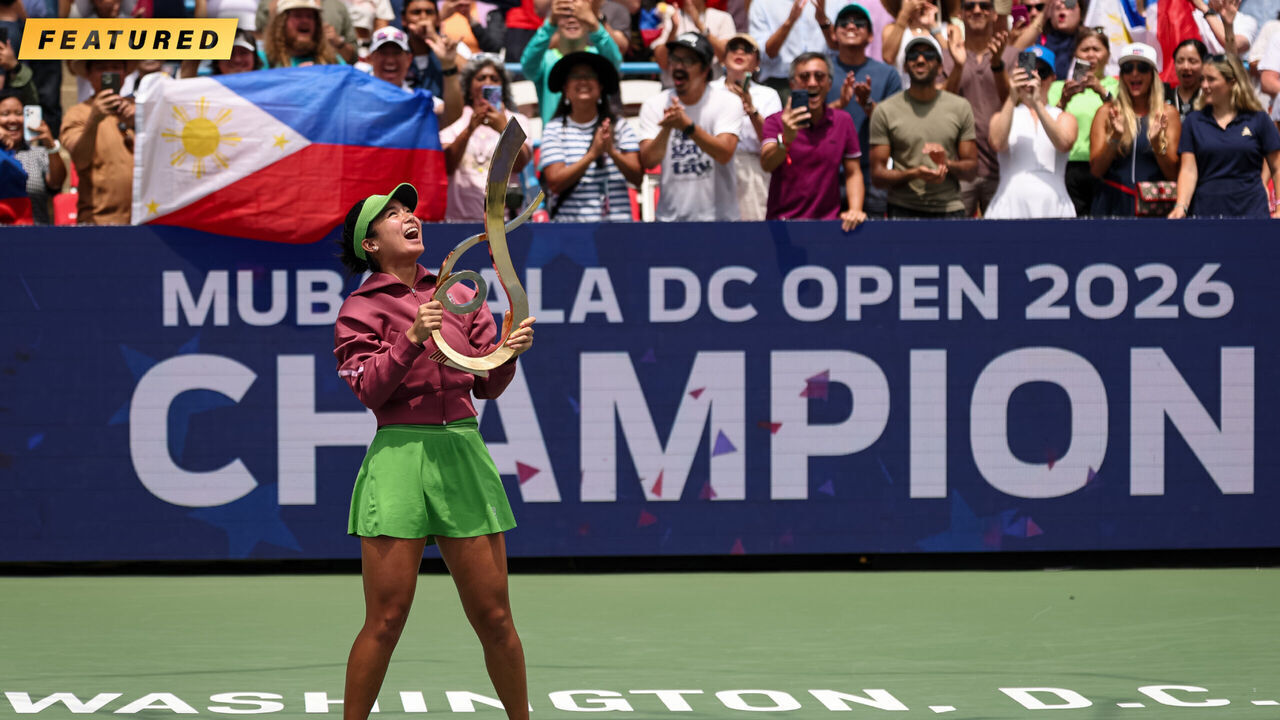
She then claimed her maiden WTA tour-level crown at the DC Open, beating Qinwen Zheng, Leylah Fernandez, Elina Svitolina, Naomi Osaka, and Jessica Pegula to make her top-20 debut.
"Eala Mania" has taken the tennis world by storm, as Filipinos across the globe have packed stadiums to support the rising star.
Her recent stop at the National Bank Open in Toronto drew 39,923 people across four night matches. Tournament director Karl Hale said tickets sold out in 30 minutes after Eala's opening tilt was confirmed, and all her matches had to be played on center court to meet demand.
The marquee Canadian event turned into a homecoming of sorts for Eala. The grounds were filled with people draped in Philippine flags and wearing Eala's Nike clothing collection, which features the country's national flower. One food vendor also offered chicken adobo and lumpia - traditional Filipino dishes. "Bebot," a song by Filipino artist Apl.de.ap of the Black Eyed Peas, played during a changeover.
Following a second-round win over Alycia Parks, Eala sent a raucous Toronto crowd into a frenzy when she greeted them in her native tongue.
EALA MANIA! 🤩
— Sportsnet (@Sportsnet) August 6, 2026
Alexandra Eala shows love to the Toronto crowd after her win 🇵🇭 #NBO26 pic.twitter.com/YiFVj29rC2
"I am kind of just like a drop in the ocean when it comes to Filipinos and their pride for their culture and where they come from," Eala told theScore following her Round of 16 exit in Toronto. "I do a lot to kind of represent my country, and I'm very proud of it. But you see, the stadium was full of people who do the same thing, right?
"I guess that just shows you what kind of a community we are, what kind of people we are, and how supportive we are of each other."
Desirae Krawczyk swells with pride talking about how Eala has grown tennis in the Philippines. The doubles specialist's mother is half-Filipino, and she's developed a connection with Eala through their shared roots.
Krawczyk has noticed more Filipinos coming to her own matches since Eala joined the tour. The four-time mixed doubles major winner last visited her mother's homeland for a tournament when she was 12 and is eager to return, whether to host a tennis clinic or to partner with Eala in doubles.
"It's insane. The things that she's done for her country and for herself as being the only (singles) player right now representing the Philippines has just been really cool to see," Krawczyk told theScore. "She's so young. She's also doing such a good job with handling the pressure so well. Just playing and enjoying it out there."
Coco Gauff got a taste of "Eala Mania" during their first-ever meeting last February in the Dubai Open quarterfinals. While it was a one-sided affair with the American prevailing 6-0, 6-2 in just over an hour, Gauff was so blown away by the atmosphere Eala's fans created that she went out of her way to recognize them in her post-match interview.
"I think it's so great for the sport and great for all the players. Obviously, she's the one leading the charge in that region, but I think it opens up new eyes," Gauff told theScore. "After my match in Dubai, I had a ... bunch of Filipinos come to support me just because of my comments after the match toward Alex. I thought that was super cool.
"I think that's just so great that one player can really bridge the gap between a sport and a nation that maybe hadn't had that representation before."
Eala isn't home much because of the WTA's demanding schedule, but she doesn't need to be in the Philippines to see the difference she's making.
Reminiscent of how communities gathered for Manny Pacquiao's boxing fights, watch parties for Eala's matches are being held all over the country. Once-empty tennis courts are now being used as the sport's popularity grows.
However, accessibility remains a challenge. The tennis court Eala played on as a child was painted over a basketball court. The Philippine Tennis Association says fewer than 1,000 courts are scattered across the archipelago, though local governments are rushing to build hard courts, according to Agence France-Presse.
Additionally, the tennis federation is moving forward with plans for a national hub, which will include an academy and an 8,000-capacity stadium.
"From what I've been told, it's very difficult to get courts nowadays," Eala told theScore. "Online, I'm seeing everybody is playing tennis, people of all ages picking up rackets.
"I hear stories directly from them of how they have picked up tennis or other racket sports. ... I think tennis is well loved back home, and anything I can do to help that cause, it's my pleasure."
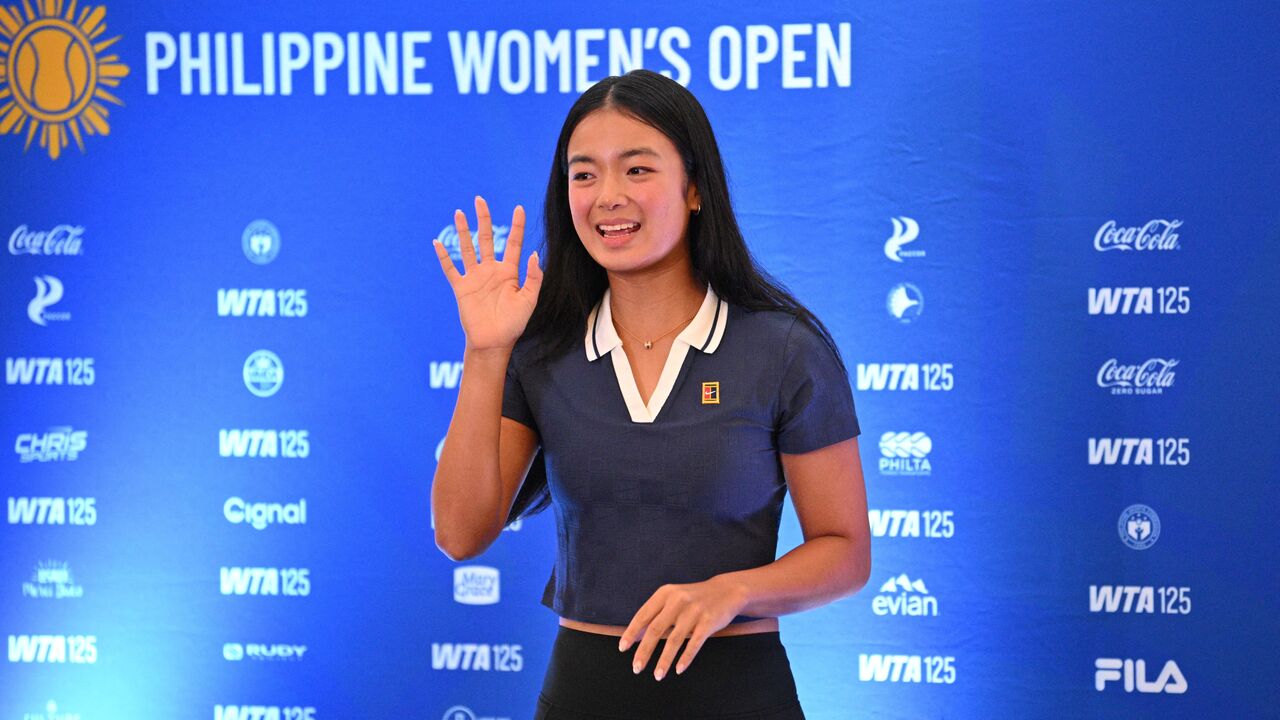
One of the rare times Eala has traveled back to her birthplace midseason was in January for the inaugural Philippine Women's Open in Manila. Although she was eliminated in the quarterfinals of the WTA 125 tournament, she described the experience as "super meaningful" - an opportunity to compete on home soil with her fellow countrywomen, who all received wild cards for the event.
Growing up, Eala didn't have a Filipino player to look up to. Nowadays, she knows what it means to give young Filipinos someone they can see themselves in and aspire to be.
"All these big tournaments that people have in their hometowns, they have memories of going and attending those tournaments as kids," Eala told theScore. "And then, it becomes kind of full circle, and it becomes a goal for them to look forward to as they develop in their tennis journey.
"Hopefully ... these WTA tournaments in Manila can be that for the Filipinos, too."
Eala has a lot on her shoulders as the nation's lone tennis hope. Philippine President Ferdinand Marcos Jr. has recognized her accomplishments and drawn comparisons to Pacquiao for the way she's putting Filipino tennis on the map.
As she's climbed the rankings, Eala admits it's been a process managing all of the "extra things" outside of tennis. But the World No. 18 is taking it all in stride.
"It's not an extra burden," Eala said. "It's definitely an honor to represent my country, and I'm super grateful for all of the love and recognition that I'm getting. In those specific moments when I'm living it, they do become quite overwhelming, especially when I'm experiencing things for the first time, but all in a positive light."
Eala's first breakthrough moment came at the 2025 Miami Open. As a wild card, she shocked major champions Jelena Ostapenko, Madison Keys, and Swiatek before falling to Pegula in the semifinals. Several months later, Eala became the first woman from the Philippines to win a Grand Slam match, erasing a 5-1 deficit in the third set to stun No. 14 seed Clara Tauson.
It's your moment Alexandra Eala! pic.twitter.com/QV3rUmeAqb
— US Open Tennis (@usopen) August 24, 2025
Eala's momentum carried over into the current campaign. The lefty has a career-high 31 tour-level victories and has reached the Round of 16 or further at four WTA 1000 events. Seven of her wins this year have come against top-10 foes, including her triumph in Washington over Pegula.
In their first showdown in Miami, Pegula said she felt Eala was playing off adrenaline. Now, the 2024 US Open finalist sees a transformed player, one who's more confident and has learned to manage her emotions better after several notable victories.
Pegula also praised Eala's aggressive return style, crediting it with turning the tables in their DC Open championship match. The Filipina broke Pegula's serve five times and took the last nine games en route to a third-set bagel.
"Girls that kind of play like that, they can go on swings of momentum very quickly because everything starts happening very fast if you're the opponent," Pegula said.
"All of a sudden, she's changing the ball (direction), taking it early, hitting winners. You're out of position, and things kind of move quickly. I think that's probably one of the reasons why ... she can flip matches really quickly."
Eala's serve doesn't pack the biggest punch, but she's found a way to make it effective, specifically her second serve. As a southpaw, Eala's variation, placement, and use of spin are more impactful and have frustrated some of the WTA's top players.
"It kind of curves into you a little bit (on the deuce side), and it curves away from you on the ad side," said fellow rising star Iva Jovic, who's won both of her meetings against Eala. "It's slower, but it bounces a lot. If you're not very sharp with your footwork, it can cause trouble.
"Anything that's a little different is hard because we're used to just the flat, big serves, and then she follows it up well with her groundstrokes."
Eala says her time at the Rafael Nadal Academy played a big role in her development. At age 13, the Quezon City native left home on a scholarship to train and attend school at the Mallorca-based facility. Over the years, she's received advice from Nadal himself, as well as his uncle and longtime coach, Toni, who oversees her progress.
Eala's primary coach, Joan Bosch, was one of her early mentors at the academy and remains an important voice in her corner.
"I trust him a lot," Eala told theScore. "I think we work great as a team alongside my other two coaches from the academy. ... It's really important to have someone who backs you and believes in you. I feel that from him.
"I feel like we have good energy, good relationship. We're able to be honest with each other. We're able to have an open line of communication."
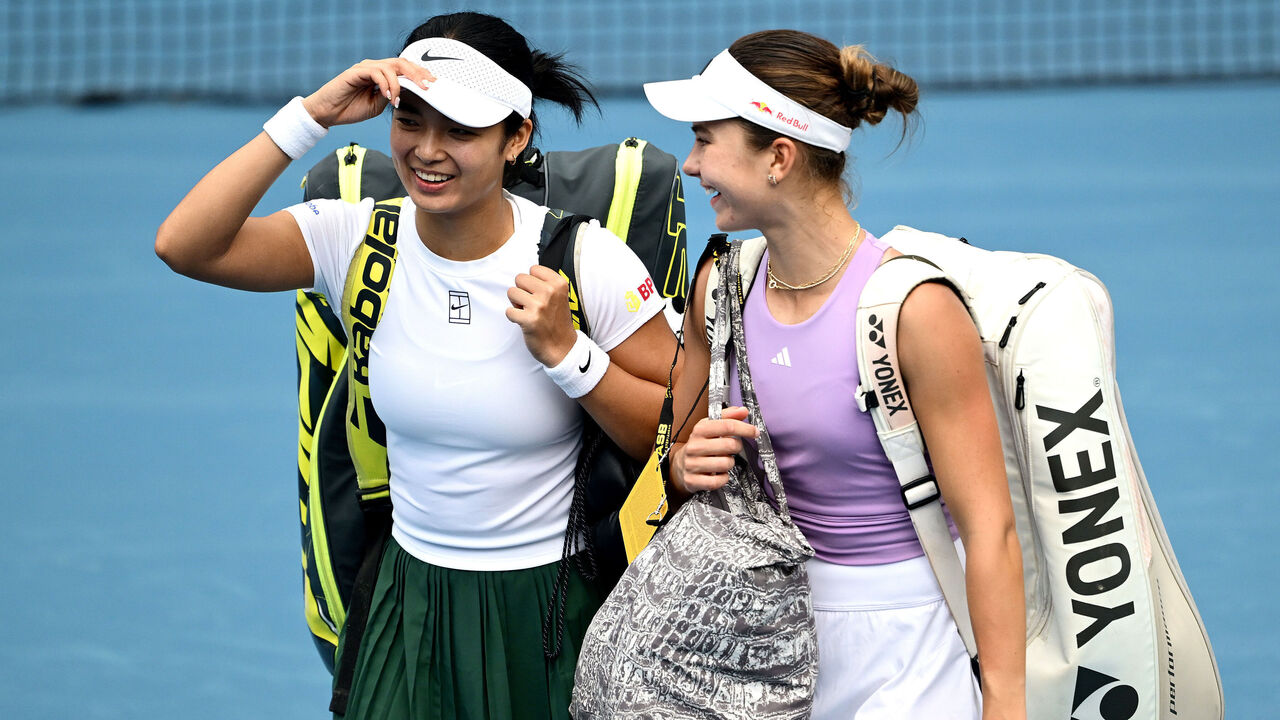
The cutthroat nature of tennis hasn't stopped Eala from developing friendships with her peers.
Jovic didn't overlap much with Eala at the junior level, but the up-and-coming talents quickly struck a bond after teaming up for doubles at the ASB Classic last January.
The world's 14th-ranked player regularly texts Eala, with their chats covering everything from what to pack for tournaments to concerts they might attend and other off-court topics.
Jovic appreciates having a close friend like Eala amid the challenges of an individual sport.
"She has a very big heart, and she's one of those people who really wants all of us to succeed," Jovic told theScore. "She wants to do the best. She obviously wants to win. But as a friend, she always wants me to win.
"She always wants the best for me. She's always supporting me. Even whenever I beat her ... she just wants us all to do well. She doesn't have that mentality of, 'I'm gonna be the best, and I need to drag you guys down.'"
Eala's visor at Wimbledon featured a Tagalog phrase, "Kapag lumago, hindi na hihinto," which loosely translates to "Once it grows, it cannot be stopped."
It's a message that mirrors Eala's flourishing tennis journey to this point and the mindset she's adopting going forward.
"I don't really like to put a cap on what I'm able to do, but at the same time, I don't really like to just put myself in a bubble either and obsess too much over that," Eala said. "I think my primary goal is to play good matches, and at a good level. I think the more I'm able to do that consistently, the more rewarding it is for me."