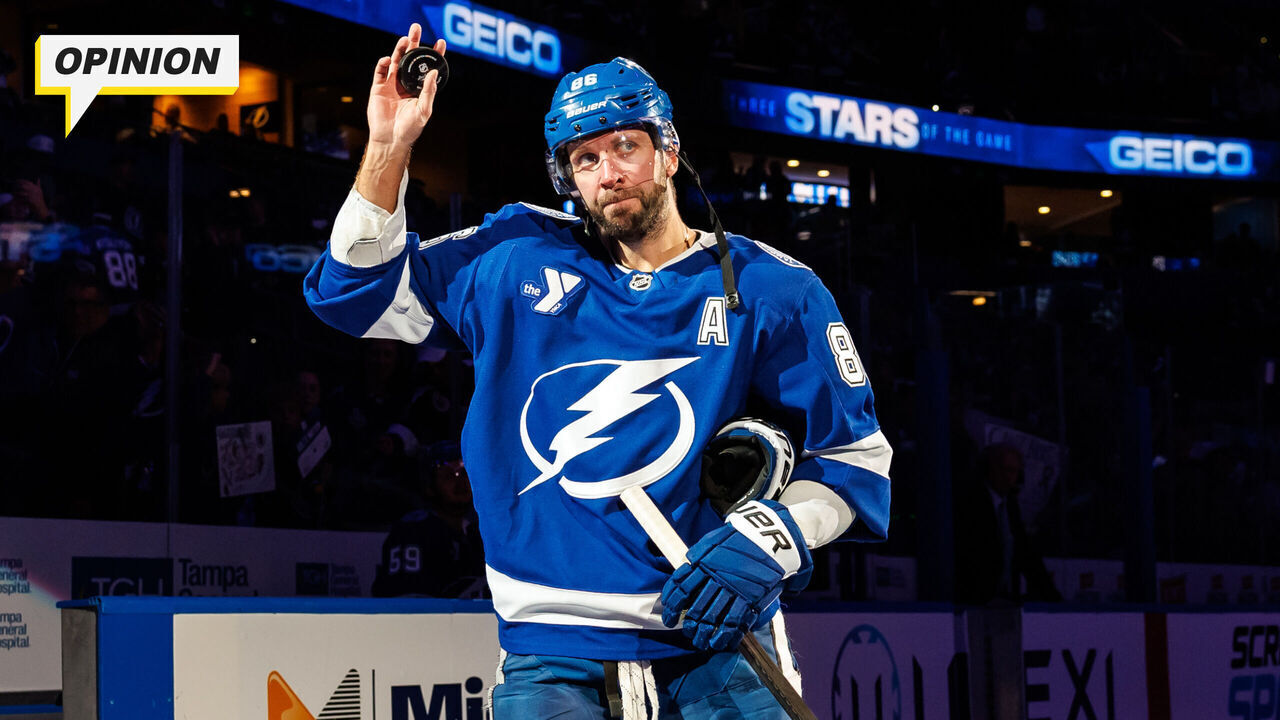
Nikita Kucherov is unhappy with his employer.
That's not uncommon. He isn't even mad at his boss, but rather his boss' boss, which is, in fact, relatable for a lot of employees.
What isn't particularly relatable for most of us is that the source of Kucherov's discontent, Tampa Bay Lightning general manager Julian BriseBois, wants to pay him around $16 million per year.
Kucherov, you see, thinks he should've been offered much more for what's likely to be his final contract - something near $20 million annually - even though he'll turn 34 before the deal begins. More importantly, he shouldn't have needed to ask for it - or be forced to hash out such things with Tampa Bay's front office, in general. If the organization respected him, it would have offered him a top-of-market deal at the start of negotiations.
You can see where Kucherov is coming from. Cale Makar got $20 million per year on his deal, which kicks in next season. Macklin Celebrini received $18.8 million. Leo Carlsson signed for $18 million. Celebrini and Carlsson are barely even adults, and they play for San Jose and Anaheim, respectively - teams that haven't sniffed real success in ages. Kucherov has won multiple Hart and Art Ross Trophies - one of those MVP awards came just last year - and a couple of Stanley Cups. His resume is impeccable, and he's as responsible as anyone for making the Lightning a powerhouse.
And yet the most significant thing about Kucherov's impasse with the Lightning, which has led to a trade request that doesn't seem like a negotiating ploy, is that it all comes down to money. Not the chance to play on a winning team, in a big market, or with a sibling or countryman. Just money.
In recent years, it's become common wisdom that things are different in the NHL now. As a number of star players have forced their way off their teams, often away from Canadian cities, we've heard that teams in the southern United States have unbeatable appeal. Not only is the weather pleasant in winter, but being a hockey player in a market that's mostly crazy about football grants even the best NHL stars a degree of anonymity that isn't available in a hockey-mad city.
Tampa offers that, plus the Lightning have been perennially good, with a highly respected coach in Jon Cooper and a collection of high-end players. Being located in Florida, the Lightning also carry the allure of having no state income tax, which presents tremendous savings on contracts that can run into nine figures. That carrot, as we're often told, makes it impossible for other teams to compete on salary because players keep more of their earnings in states such as Florida and Texas.
Unless, like Kucherov, they decide that they want out of their tax haven anyway.
None of this is a knock on Kucherov. His agent has been unusually talkative in recent days and has made it sound like there was simply a relationship breakdown between the player and team that probably could've been avoided if everyone sat in a room and hashed things out months ago.
But they didn't, and here we are, with one of the best players in the NHL feeling slighted by the only team he's ever played for.
Maybe this is all high-level bluffing and Kucherov ends up finishing his career with Tampa Bay on a salary that he feels is reflective of his accomplishments. But it certainly seems more likely that a successful, elite player who still has some high-production years left is about to force his way out of Florida, which has been considered one of the NHL's most desirable destinations for a while now.
If Kucherov ends up in Las Vegas or California, that wouldn't do much to derail the narrative that warm-weather cities have become too attractive for players to resist. But what if he ends up accepting a trade to - and signing a new contract with - a northern team such as Boston or Philadelphia? What if, gasp, he moves to a Canadian team?
Such a scenario wouldn't undo a yearslong trend of the most sought-after NHL players traveling from north to south. But it would be a significant moment regardless, one that suggests teams outside the Sun Belt can compete for the best players in hockey despite having fewer selling points.
A giant contract that pays top money over many years will keep a lot of players from worrying about finer details such as the weather and taxes.
Nikita Kucherov could yet be the NHL's first superstar to leave the South and head north. Unless he's putting us on. I'm not ruling it out.
Scott Stinson is a contributing writer for theScore.