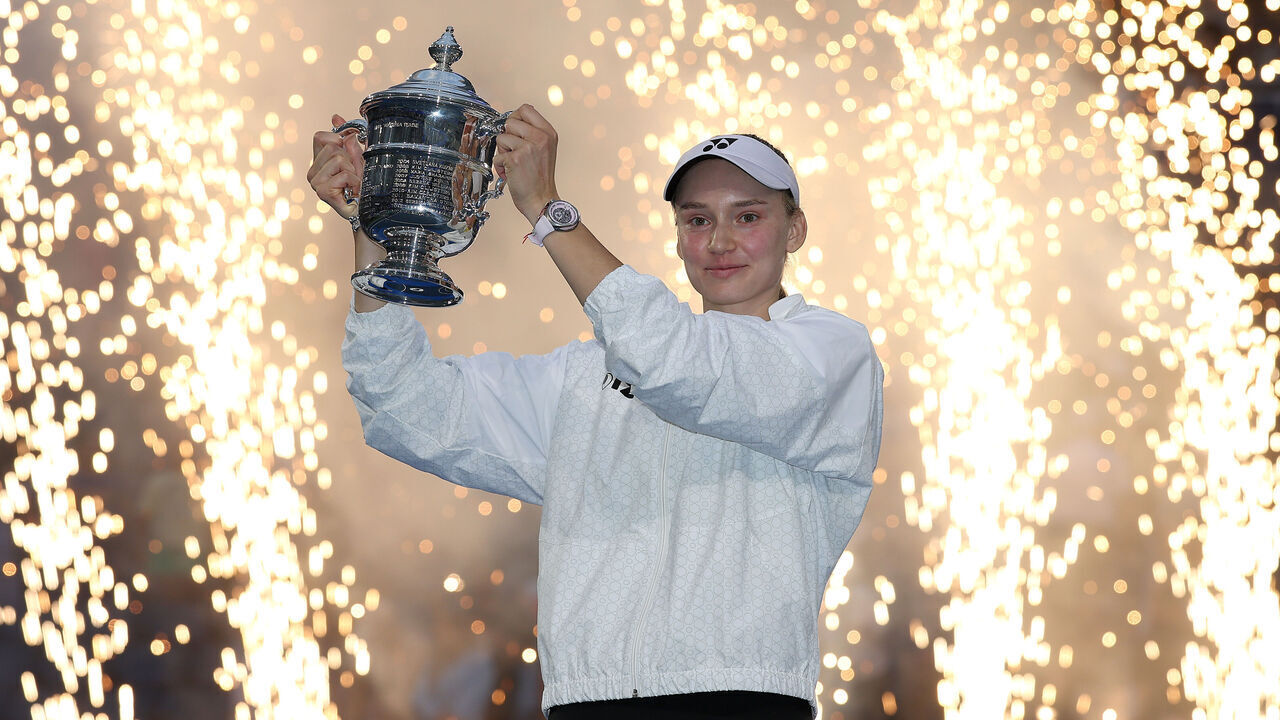
NEW YORK (AP) — Elena Rybakina came to New York and took everything that had belonged to Aryna Sabalenka.
First, it was the No. 1 ranking in women's tennis, then the US Open trophy.
The tournament that for so long was a struggle for Rybakina turned into the site of her coronation.
Rybakina won her first US Open title and punctuated her climb to the top of her sport by beating Sabalenka 6-4, 5-7, 6-2 on Saturday.
TOP OF THE WORLD 🌎
— US Open Tennis (@usopen) September 12, 2026
Elena Rybakina defeats Sabalenka 6-4, 5-7, 6-2 to claim her first US Open title! pic.twitter.com/7XA520vTei
Rybakina had already been guaranteed to replace Sabalenka at No. 1 in the rankings next week and for good measure took the title that Sabalenka had won the previous two years.
"It's tough to find words right now, honestly," Rybakina said. "I don't expect nothing like this coming to this tournament. I've been dealing with a little bit with an injury, but somehow everything aligned together on my side."
It was the third Grand Slam title for Rybakina and the second this year — both against Sabalenka on hard courts. She opened the season by beating Sabalenka for the Australian Open title.
This time, she stopped Sabalenka's 19-match winning streak at the US Open, where she hadn't lost since falling to Coco Gauff in the 2023 final.
Rybakina earned $5.5 million, the largest prize in Grand Slam history, and tied Sabalenka and French Open winner Mirra Andreeva with a tour-high three titles this season.
Sabalenka falls short of third straight title in New York
Sabalenka took home $2.8 million but it was clear how little that meant to her, as she smashed her racket after a brief hug with Rybakina at the net.
Sabalenka was trying to become the first person since Serena Williams from 2012-14 to win three in a row at Flushing Meadows.
"I was just out there competing, trying to do my best with what I had there today," Sabalenka said. "Not good enough."
Rybakina dethroned the champ without even having her best stuff. The WTA Tour leader in aces got less than half of her first serves in but instead put Sabalenka under constant pressure with a strong return game, racking up 12 break chances and converting three, which was all she needed.
The third meeting of No. 1 vs. No. 2 in a US Open women's final since 2000 was the first to go the way of the challenger. Williams was the top seed for the other two, beating her sister Venus in 2002 and Victoria Azarenka in 2013.
The numbers didn't signify much this time, because they are going to flip Monday. Sabalenka has held the top spot for 99 consecutive weeks, but Rybakina gained enough points to unseat her simply by reaching the semifinals.
She didn't stop there.
The 27-year-old, who was born in Russia but represents Kazakhstan, won her first major title at Wimbledon in 2022 and now needs just the French Open to complete the career Grand Slam.
And it's clear her power — and her ability to absorb her opponent's — was something that unnerved Sabalenka.
"Her serve is amazing, the way she's able to step in and overpower you on court, and especially if it's a US Open court where it's super fast, it's definitely a huge advantage for her," Sabalenka said. "A lot of things make her dangerous."
A native of Belarus, Sabalenka sometimes swings from her heels, like a golfer trying to unleash a 300-yard drive, grunting "Aaaaahhhh!" as she takes her mighty cuts.
Rybakina's power comes more easily. There is little sound coming from her side of the net besides the squeaking of her sneakers, and she rarely shows any hint of stress.
"I think Elena is probably — not nonchalant, I don't want to say that, because she's not nonchalant — but just no reaction ever," Gauff said after losing to Rybakina in the semifinals.
Rybakina did show some frustration after pulling a backhand wide with a break point in the opening game of the third set, but soon she had taken charge of the match for good.
Sabalenka had won the two other meetings this season, on the hard courts at Indian Wells and Miami, and leads their rivalry 10-8.
But her season then took a strange dip after those victories. Sabalenka fell to Naomi Osaka in the fourth round at Wimbledon, then returned to action with consecutive fourth-round exits in Toronto and Cincinnati.
Rybakina has learned to love New York
Rybakina had to take a brief break after she was forced to stop playing in her quarterfinal match against Iga Swiatek in Cincinnati because of a foot injury, but she was healthy in time for a tournament where she had never done particularly well, failing to advance past the fourth round until this year.
“I honestly was coming here for the last 10 years, and it was never successful -- nothing close to that,” Rybakina said. “It’s just incredible. I’m falling in love with New York more and more.”
Arthur Ashe Stadium, meanwhile, had been Sabalenka’s house, with four straight trips to the final and six to at least the semis. Whatever troubled her during the summer seemed forgotten once she was back in New York — until Saturday.
Sabalenka repeatedly looked toward her coaches’ box with her palms up, wondering why everything was going so poorly, and showed much more frustration than that when she double-faulted to hand Rybakina a 3-2 lead in the first set. Rybakina hit the serve back and the ball bounced directly to Sabalenka, who whacked it into the crowd, earning a warning from the chair umpire.
Sabalenka eventually began putting consistent pressure on Rybakina in the second set. She picked up two break points with a chance to end the set with a 5-4 lead, and though Rybakina won four straight points to get out of that jam, Sabalenka got another chance in the next service game and this time capitalized, stepping into a return to set up a miss by Rybakina.