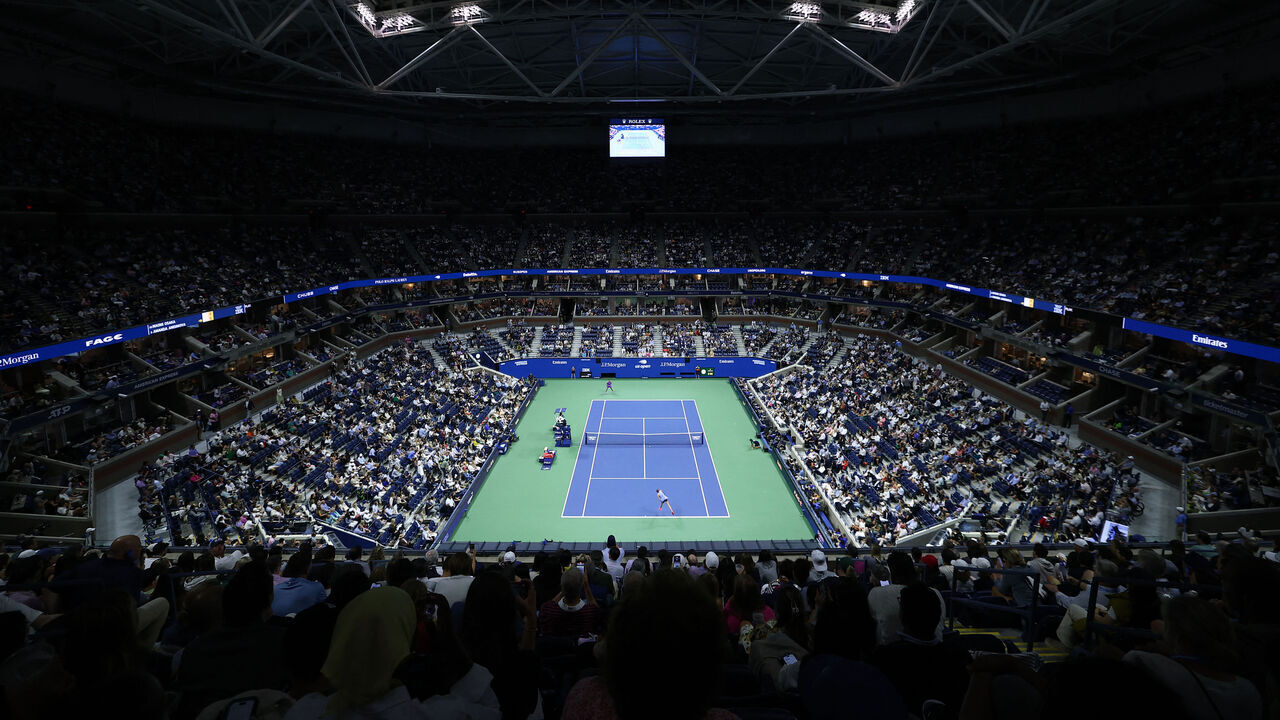
NEW YORK (AP) — The U.S. Open was a week old by the time Aryna Sabalenka and Carlos Alcaraz opened their title defenses.
What once was a two-week quest for a Grand Slam championship now extends into a third week, and U.S. Tennis Association CEO Craig Tiley was asked how he hoped to continue that growth.
“Four weeks,” he said with a smile.
Some players might fear he is serious.
They were already becoming wary of an overcrowded schedule that makes it hard to find many breaks, even before the U.S. Open moved up the beginning of the singles main draw last year to make it a Sunday start.
“I just hope they will not start on Saturday at some point, you know? And then on Friday and on Thursday, Tuesday, Wednesday,” said Marta Kostyuk, the No. 11 seed from Ukraine. “So I hope this is it.”
Kostyuk was one of the winners Sunday, and those players get the benefit of two days off before their next matches. Sabalenka and Alcaraz started Monday, the former opening day, and top-seeded Alexander Zverev and 2023 champion Coco Gauff are scheduled Tuesday on the final day of a first round that until last year was completed over two days.
“So they’re finding ways to extend the tournaments, which I think is tough for the players,” said Canadian Denis Shapovalov.
Leylah Fernandez, the 2021 runner-up in Flushing Meadows, said she would enjoy the extra day off after her victory Sunday to spend time with her sister, who is in New York with her.
But Shapovalov, a 2021 Wimbledon semifinalist, argued that an extra day between matches doesn’t mean more time off.
“Being off is when you’re at home, able to sleep in your bed and not focus on tennis, right?” he said. “We’re still going to have to come back tomorrow, practice the next two days. You’re still in that match environment, tournament environment where I’m locked in and I’m not doing things that I would be doing when I’m off. You know, having a brownie.”
The expansion to a three-week event set in last year, when along with starting singles play on Sunday, the USTA shifted the mixed doubles tournament to a two-day event on the Tuesday and Wednesday preceding it. That was in hopes that top singles players would compete, which most of them wouldn’t when it was contested once their priority event began.
Another day was added to that this year with a qualifying tournament that was held Monday for the final two spots in the 16-team field. With more real matches beyond the singles qualifying tournaments that take place the week before, and admission to the grounds free, there were huge crowds for what the USTA calls “fan week,” and organizers clearly want more.
“This will become the tennis Disneyland,” Tiley said.
He stressed that doesn’t necessarily mean extending the length of the tournament, but by finding more types of events to do during it.
But extending events is exactly what tennis seems to be doing these days.
It's perhaps felt more at the Masters 1000 level, just below Grand Slams. Those have swelled to 10 days, so long that players have trouble keeping track of time. Tommy Paul was noting how well his fellow Americans performed at the recent ones in Montreal and Cincinnati, reaching the final weekend, when he caught himself.
“I say weekend. I think the finals in Montreal was, like, Wednesday or something,” Paul said.
Close. Ben Shelton won the title on a Thursday.
Some players point to the obvious, that longer tournaments mean shorter time to recover before the next event for those who do well. Frances Tiafoe got to the final in Cincinnati, then had to pull out of the mixed doubles, where he was supposed to partner with Fernandez, for more rest.
“To be honest, speaking in the locker rooms, I don’t think anybody’s a fan of how long the seasons in general are right now, fans of these three-day starts, fans of the 10-day Masters,” Shapovalov said. “You know, I think everything’s just gotten too long.”
___