
Ted-Jan Bloemen never wavered in his belief that he would, one day, stand atop the podium at the Winter Olympics. He just needed a chance.
On the surface, it seemed as though he couldn't have asked for a better setup than the one he inherited; born in the Netherlands, a nation madly in love with long track speedskating, Bloemen would have every opportunity to succeed.
The sport is, in no uncertain terms, an institution in the country, with eight pro teams, 80 full-time skaters, and a junior program that boasts roughly 7,500 youngsters, the talent crop is beyond rich.
By his own admission, Bloemen grew up in the "biggest" speedskating country in the world. "You want to make it there," he said.

And even that may be underselling it, slightly.
The Netherlands owns long track speedskating in a way no other country can lay claim to a single sport. Despite what Katie Couric may think, it has nothing to do with the Dutch getting around their respective cities by skating across frozen canals.
Of the 130 Winter Olympic medals ever captured by the nation, 121 have come in long track speedskating - 42 of those have been gold. From 1980 to 2006, the Netherlands won 47 Winter Olympic medals in total. All of them came on a long track oval.
| Winter Olympics | Total Medals | Speedskating Medals | Speedskating Gold |
|---|---|---|---|
| 1980 (Lake Placid) | 4 | 4 | 1 |
| 1988 (Calgary) | 7 | 7 | 3 |
| 1992 (Albertville) | 4 | 4 | 1 |
| 1994 (Lillehammer) | 4 | 4 | 0 |
| 1998 (Nagano) | 11 | 11 | 5 |
| 2002 (Salt Lake City) | 8 | 8 | 3 |
| 2006 (Torino) | 9 | 9 | 3 |
Seven of their eight podium spots in 2010 came in the punishing sport, while 23 of 24 Dutch medalists in Sochi were long track speedskaters - the lone rebel came, perhaps predictably, in short track.
It's a national obsession.
The trend of dominance continued in South Korea. Of the 42 long track speedskating medals on offer in PyeongChang, an orange-clad athlete (or team) walked away with 16 of them. The Netherlands, led by double Olympic champion Kjeld Nuis, gobbled up seven of the 14 golds available at the Gangneung Oval over the past two weeks.
All of that is to say Bloemen, who showed promise at a young age - he finished fifth at the World Junior Speed Skating Championships in 2006 - could easily have been draped in an orange and blue skinsuit in PyeongChang, instead of a red and black one.
But athletic maturation isn't linear. His development stalled. Amid the intense internal competition, he felt as though he was being ignored.
"I would get a chance for one season and then they would decide I was not good enough," Bloemen recalled. "At some point I just decided I didn't want to be a part of that anymore and take matters into my own hands."
A fresh start in Canada
So that's exactly what he did.
Bloemen, whose father, Gerhard-Jan, was born in New Brunswick prior to emigrating to the Netherlands, went in the other direction. He arrived in Canada in 2014, set up shop in Calgary, and obtained dual-citizenship.
Did Canadian speedskating coach Bart Schouten know how monumental that decision would be? It certainly seemed like it.
"He set the eighth-fastest time in the world last year, but there were seven Dutch guys in front of him," Schouten told the Canadian Press in 2014, when rumblings of Bloemen's impending switch began to make news in speedskating circles. "If he were to skate for Canada, he'd basically be the fastest non-Dutch guy."

The potential to be slapped with the "mercenary" label was obvious. That's what it looked like to some.
Bloemen, 27 years old when he made the decision to uproot across the Atlantic, was cognizant of that. And he was adamant there was nothing nefarious about his decision to ditch the country of his birth. This wasn't a cheap trick just to collect some Olympic medals.
He's maintained, without fail, that he wanted to embrace his adopted home. He wanted to be Canadian.
"When I decided to move to Canada, I decided I wanted to be a Canadian. I wanted to be part of this Canadian team as a Canadian. I didn't want to be just a Dutch guy skating for the Canadian team," Bloemen, as quoted by the Toronto Star, said. "That would feel like cheating a little bit."
Regardless of how anybody viewed his move, his performance would ultimately decide whether his life-altering decision was the correct one. His potential was obvious, but, for one reason or another, he was yet to truly announce himself as a legitimate threat on the world stage.
The early returns were spectacular.
Speaking glowingly and crediting the comradery of his new team, which he described as a "family" - a feeling Bloemen says he never experienced while in the Dutch setup - the newly-minted Canadian started making waves.
In 2015, a year after swapping orange for red, Bloemen broke the world record in the 10,000-meter. He followed that up by establishing a new benchmark in the 5,000-meter in 2017.
Sometimes, everything just clicks.
"The way I've always seen it is that I have a belief in myself and have the potential to win races," he told Devin Heroux of the CBC ahead of the Winter Olympics. "I've always believed I could do this if I got a fair chance."

That's exactly what he was getting in Canada, and he got the opportunity to crown his newfound success in PyeongChang, where, at 31 years old, he was making his first Olympic appearance.
Coming full circle
Bloemen couldn't have scripted it any better.
Sven Kramer, the decorated kingpin of the Dutch speedskating hierarchy, stood in his way. Overcoming the imperious athlete who best symbolizes the Netherlands' dominance of the sport would almost be too poetic. Too perfect.
In their first clash of the games, Kramer got the better of Bloemen in the 5,000-meter. But it was the longer distance that the former really wanted.
Kramer, 31, made no secret of desire to win the 10,000-meter heading into PyeongChang. It wasn't his singular focus, but, given his excruciating relationship with this particular race, it was close. The 10,000-meter is, famously, the only Olympic gold that had eluded his CV. The Dutch icon crossed the line quickest in the event at Vancouver 2010, but was famously disqualified after a mistake by his coach led him to commit a lane violation. Four years later in Sochi, he had to settle for silver - behind one of his teammates, of course.
Back home, the race was being billed as the "biggest" moment of the Winter Olympics for the Netherlands. For the Dutch, this was the showstopper: it was Usain Bolt getting into the blocks for the 100-meter; it was Michael Phelps hitting the pool with gold on the line. A true Olympic spectacle.
As Kramer came to the line as part of the final pair, everything was so beautifully poised. Bloemen, skating just before him, set the mark to beat by delivering a time of 12:39.77. Kramer, the reigning world champion at the distance, had posted a 12:38.89 just last February, on the same track.
Bloemen couldn't watch, literally covering his eyes as he sat, waiting for his onetime compatriot to round the Gangneung Oval 25 times.
Around the midway point, though, the mood changed. Kramer, easily the greatest long track speedskater in history, crumbled, quite remarkably. Each passing lap became a slog.
The 10,000-meter race, the sport's most grueling, can fell the world's best. Even if they're built like two glorious tree trunks, once the legs start to wilt, there's no getting that pace back. The ice, so accommodating when you're effortlessly gliding across it, becomes unforgiving, almost as if it's fighting back, sapping energy with every turn.
As Kramer's splits slowed and his lap times continued to climb well over the 30-second mark, Bloemen began sobbing. The job was done. Vindication.
The moment TJ Bloemen realized he's got gold. First Canadian men's medal on the 10k since 1932 Lake Placid. cc @bruce_arthur @ArashMadani @tsnjamesduthie pic.twitter.com/fZqgpAyqD9
— Remko Rinkema (@RemkoRinkema) February 15, 2018
"It's a slow realization that you're becoming an Olympic champion, it's incredible," the Canadian told reporters, recalling how, as he watched Kramer falter, his nerves began to make way for blubbering excitement.
In the event he wanted more desperately than any other, Kramer ultimately finished sixth, 21.25 seconds off the pace.
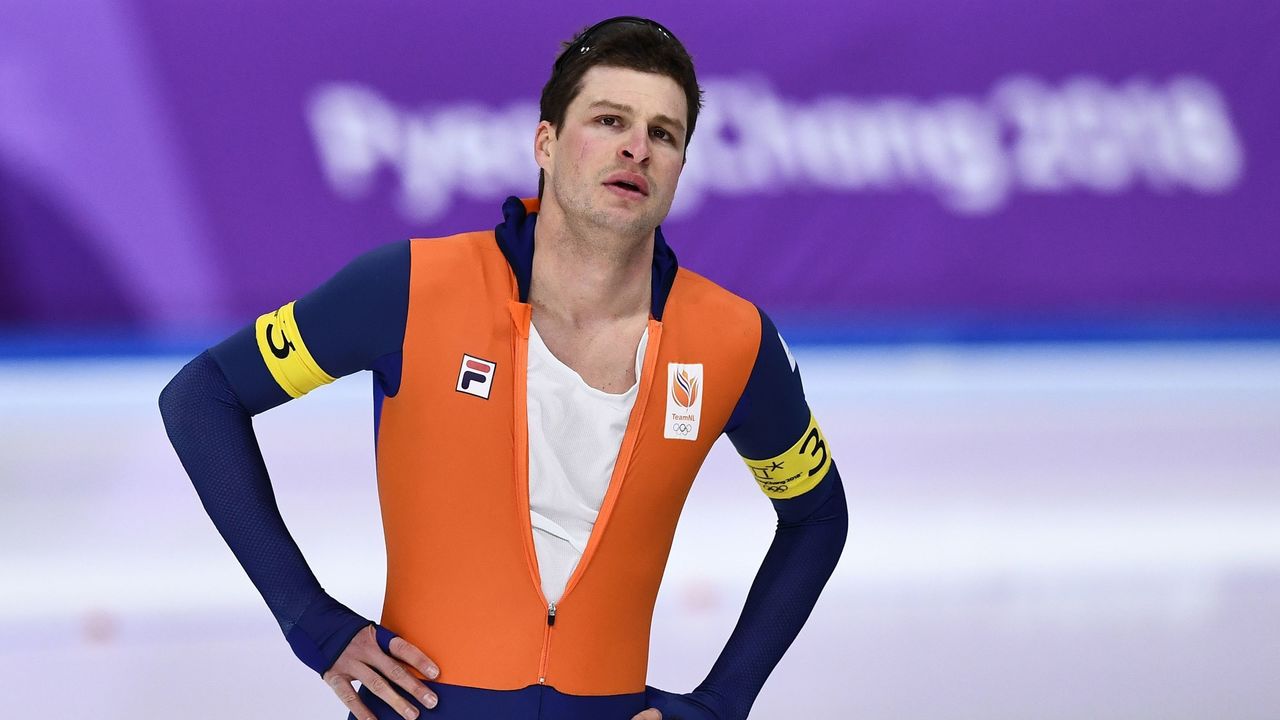
Nobody enjoys losing. It was inevitable that Kramer would be disappointed. Pissed off, even. He may have been both, but more than anything, he looked broken. Kramer crossed the line with a nonchalance that signaled just how thoroughly beaten he was.
"It has affected me to my core and I am struggling to deal with it and, of course, it is keeping me up at nights," Kramer told Dutch television afterwards, per Reuters.
And to be beaten by Bloemen, of all people: a late-bloomer, and a "really proud Canadian," deemed by the Dutch not to be good enough.
As his name was announced and he took his place atop the podium, Bloemen, somehow finding another burst of energy after his incredible skate, bounced up and down, throwing his arms in the air with vigor.

He did it. Just like he always knew he could.
(Photos courtesy: Getty Images)


