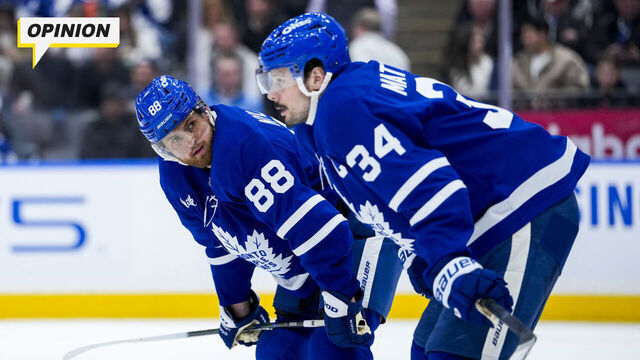
Picture this: The year is 2036. The Toronto Maple Leafs have been eliminated from the playoffs after a disappointing first-round exit. Thirty-eight-year-old Auston Matthews, a three-time Olympic gold medalist, is left to mutter at his locker about tough breaks and close misses.
The headlines throughout the city ask, "Should the Maple Leafs finally tear it all down?"
This scenario isn't as implausible as you might think. Asking whether the local NHL team should start from scratch or run it back has become as much a part of Toronto's springtime as repairs to the Gardiner Expressway.
Even this year, during an absolute calamity of a season in which the Leafs have been surpassed in the division standings by teams they used to dominate - Buffalo, Detroit, Montreal, and Ottawa - there has been debate over whether Toronto needs to keep tinkering or begin a full rebuild.
That's a ludicrous question.
It was one thing when the Leafs were a strong regular-season team that kept losing tight playoff series, but it's quite another when they've looked hopeless for months. They came back from the Olympic break needing to make a push for the playoffs but instead recorded three straight lopsided losses followed by a slightly less embarrassing shootout loss on home ice. They now sit second-last in the Atlantic Division.
There have been zero indicators that the Leafs are close to turning it around or that they could be back in contention next season with a couple of tweaks.
And yet, it seems like that might be the plan. MLSE chief executive Keith Pelley sent a letter to season-ticket holders in late February acknowledging the team's poor results, but he also blamed injuries and the challenges of a condensed schedule in an Olympic year - factors that apply to every other team as well.
Opting not to change course would at least be consistent for the Pelley-run Maple Leafs. The front office left head coach Craig Berube in charge when the season went off the rails in the fall, and general manager Brad Treliving hasn't made a trade since mid-July, even as the flaws of his roster have become glaringly evident.

Pelley took over at MLSE in 2024. He's since gotten rid of the team presidents of the Leafs, Raptors, Argonauts, and Toronto FC, taking on a more influential role in team operations than his predecessor, Michael Friisdahl, who focused on the business side of the huge conglomerate. (It's worth noting that Pelley's hire coincided with Rogers buying out Bell to become majority owner of MLSE.)
With the exception of the Raptors, who have a taken a step forward this season and sit firmly in a playoff spot, the results have been grim. With the Leafs specifically, Pelley has a coach who has managed to generate improvement in one small area this season: the healing of that gash on his forehead picked up in an unfortunate weight room incident. And he has a general manager who's overseen a truly impressive number of roster missteps. The first was Treliving's passive start to the job in 2023, when he decided not to rush into big changes, essentially locking in the team's core for two more seasons once no-movement clauses kicked in.
That inaction eventually led to the team losing Mitch Marner last summer for pretty much nothing. Treliving then chose not to make any significant roster upgrades with the money that would've been spent on a Marner extension. And along the way, he traded away first-round draft picks for 2026 and 2027, risky decisions that turn disastrous if a team bottoms out like the Leafs have since done. (They may yet salvage the 2026 pick, which is top-five protected, if the draft-lottery balls fall their way.)
It's impossible to make the case for bringing back either Berube or Treliving next season. But it would be even more bizarre to let the latter manage the roster through the trade deadline - and the opportunity it brings to make franchise-altering moves - only for Pelley to clean house in April and appoint a new management team.
Put another way, Treliving almost certainly won't execute tear-it-down type moves, including the unthinkable option of a Matthews trade, if he intends to be back next year. He's much more likely to move out pending free agents as trade-deadline rentals, even if those players don't fetch much of a return. That kind of deadline tinkering is a long way from the changes that the Leafs' roster needs.
Perhaps the rumblings will be wrong and the Maple Leafs will take big swings as the trade deadline unfolds. Maybe Pelley has already decided that Treliving is his guy, the man who will engineer a significant rebuild as Toronto finally says goodbye to the remnants of the Core Four era.
I'm not sure which scenario should make Maple Leafs fans more nervous.
Scott Stinson is a contributing writer for theScore.