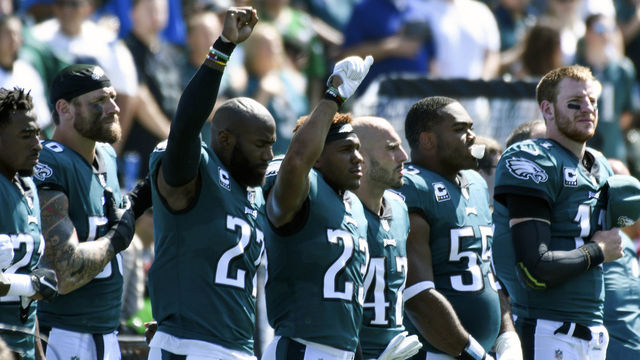
The intersection between sports and politics has seldom been more apparent to the football community than this season. Whether it was President Donald Trump waging a cultural offensive against the NFL by imploring owners to fire players who protested peacefully during the national anthem, an increasingly concentrated response from the players in return, and a host of individual efforts to rebuild their respective communities upon disaster, the notion of sticking to sports is dead.
With the conversation about racial inequality, police brutality, and criminal justice reform interceding into the world of football - an inevitable development amid one of the most politically divisive years in recent American history, a dangerous notion emerged to the forefront.
Players ought to stick to sports. They're paid to play football, not voice their political beliefs.
The Philadelphia Eagles have proven this concept to be wildly incorrect throughout the year, and - as they seek to win their first Super Bowl in franchise history - it's worth revisiting their efforts, if only to prove that there's more to life than the nuances of a 4-3 defense or a route tree.
Chris Long, Malcolm Jenkins, and Torrey Smith in particular have been among the league's most politically and socially active players throughout the season, all of whom playing major roles in leading the Eagles to an NFC-best 13-3 record. For argument's sake, if any of these players happened to have a down year on the field in 2017, perhaps a case could be made about their political activism having been detrimental to the Eagles.
Long joined the Eagles from the New England Patriots and submitted one of his best seasons in recent memory, with 28 tackles, five sacks, and four forced fumbles, serving as a key component to the team's loaded defensive front. Jenkins was named to his second Pro Bowl after recording 76 tackles, a sack, a forced fumble, and two interceptions, while Smith caught 36 passes for 430 yards and two touchdowns, giving the Eagles another solid weapon in the passing game. If political activism interfered with football for the trio, they did a great job of masking this conflict.
Upon signing with the Eagles, Long pledged to donate his entire salary to charity and has kept the league accountable from his Twitter account. Long, a native of Charlottesville, Va., has been one of the largest proponents of educational advancement and actively denounced his hometown for the white supremacist riots in August. This would almost appear to be an obvious gesture but in a climate of silence, Long's actions spoke volumes.
Chris Long gave his paychecks from the first six games of the NFL season to fund scholarships in Charlottesville, VA. He wanted to do more, so he decided to give away an entire season’s salary. That’s a story from 2017. https://t.co/NL0RoARkan
— Barack Obama (@BarackObama) December 29, 2017
"I'm playing the entire 2017 NFL season without collecting income because I believe that education is the best gateway to a better tomorrow for everyone in America," Long said via The New York Times in October.
If political activism was a distraction, the Eagles must've been superhuman after defeating the Washington Redskins on Monday Night Football in late October. Hours after moving to 6-1, Long, Jenkins, and Smith boarded a train to the Pennsylvania State Capitol where they lobbied for criminal justice reform, with a particular focus on protecting non-violent criminals. Jenkins - who met with Congress several times during the past two years - remains at the forefront of trying to change policy for the betterment of numerous African-Americans and other minorities. With the federal government's recent shutdown, it could be argued that Jenkins is doing just as much as elected politicians in trying to shape a more equitable country.
Don’t let playoffs distract you from remembering millions of people (including our soildiers) are going to work for free today until our government gets it together
— Torrey Smith (@TorreySmithWR) January 22, 2018
During a season where Colin Kaepernick was essentially blacklisted from the NFL for his political activism, a year where Trump made the NFL the object of his ire despite several other concerns of national importance, and the idea of "sticking to sports" evaporated, the Eagles found an appropriate balance. The Eagles are tasked with making the Patriots uncomfortable during Super Bowl LII; their ability to enact change and get others out of their comfort zone with the goal of improving their communities and country as a whole is laudable.