theScore's NFL draft prospect rankings series gives you everything you need to know about the top players available in this year's incoming rookie class.
👉 Jump to: QB | RB | WR | TE | OL | DL | EDGE | LB | CB | S | Top 50

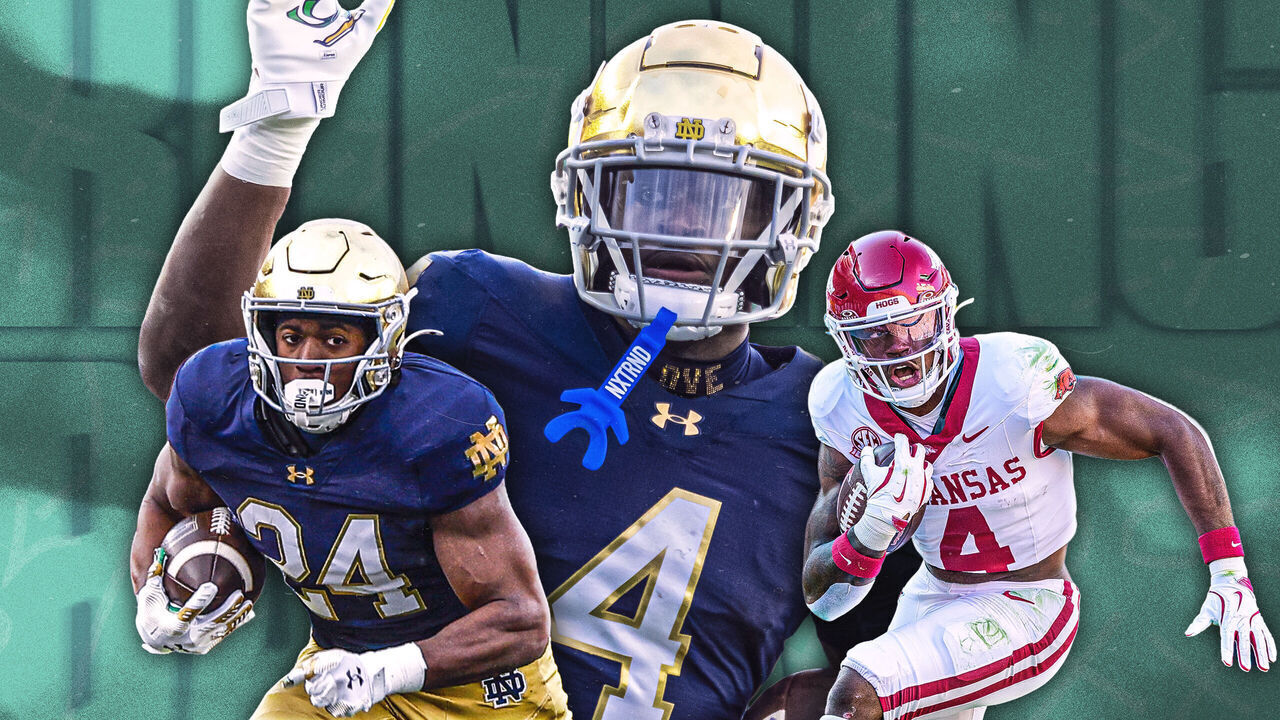
Love has top-10 pick written all over him. Any team selecting a running back that early is bound to receive criticism from the position-value crowd, but there likely won't be any regrets here. The Notre Dame product should immediately become one of the best running backs in the NFL. He demonstrates an impressive feel as a runner, allowing his blocks to develop and setting up defenders before cutting to daylight. And when it seems like the defense has him bottled up, Love's elusiveness helps him create something out of nothing.
Upon finding a lane, he accelerates instantly, and he's got the juice to erase angles and pull away from defenders in the open field. Love is one of the rare running back prospects who can offer true three-down upside from Day 1. He's a proficient receiver out of the backfield and has shown an ability to run routes lining up out wide. Plus, he's a willing participant in pass protection. If Love can run behind his pads a little more consistently, he could end up being the best player in this entire class.

Price never truly had the opportunity to become a star at the college level, as he was stuck playing a complementary role to Love. While some will question whether he can handle a feature workload, NFL teams will largely see the limited reps as a positive for his long-term outlook. Price is a proficient early-down runner who demonstrates excellent vision and decision-making as plays develop. His instincts also show in his ability to set up defenders in space, and he has the balance to shake off weak contact and keep rolling.
Price parlayed his abilities as a runner into three career kick-return touchdowns at Notre Dame, including two in 2025. However, he's had fumbling issues, so his ball security will have to improve, and there's uncertainty about whether he can assume third-down duties based on his limited opportunities in college. Regardless, he's easily the second-best back in this class and absolutely worth an early Day 2 pick.

Johnson is the most interesting mid-round back. The Nebraska standout is a decisive runner who wastes no time attacking the line of scrimmage and exploding into the second level. While a downhill running style like Johnson's might limit the elusiveness of most backs, he maintains a unique ability to cut on a dime and make defenders miss. He forced 68 missed tackles in the run game last season, the most of any player in this class (and 12 more than Love), according to PFF. He's a reliable target out of the backfield as well, having racked up 85 catches across the last two years, and he's a willing participant in pass protection.
Johnson could stand to be a little more patient, as his eager approach can lead to lapses in vision as plays unfold. He's also smaller than typical feature backs, which tends to show up in a relative lack of physicality through contact. But it's not easy to find dynamic running backs who can impact the game on all three downs. Johnson could be a productive lead back in a committee.

Coleman isn't the type of running back who brings big-play upside. The Washington product lacks the burst required to lose defenders at the next level. As appealing as those players may be, though, that's not the only way to make a living at this position. In fact, long speed tends to be overrated for running backs. Vision is the foundation of every consistently productive back, and Coleman has it in spades.
He displays strong decision-making in his ability to maximize blocking schemes and tack on extra yards. And with the contact balance that's needed to shake off tacklers at the second level, he'll generate his fair share of chunk gains. Don't overlook his three-down potential either. Coleman is capable in pass protection and as a receiver out of the backfield, not to mention he fumbled just once in 552 carries in college. He should quickly earn the trust of an NFL coaching staff.

You don't often see a sub-200-pound running back moving through defenders. With that in mind, it's fair to wonder whether Taylor might have issues maintaining his play style in the NFL. Wear and tear is also a concern. But there's so much to love based on last year's tape. The North Carolina Central transfer proved he belonged at the highest level of college football after landing at Virginia. The significant jump in competition had no effect on his ability to shake off defenders and maintain his balance through attempted tackles.
That quality, along with his feel for the position, helped him rack up 55 missed tackles on the year. For reference, that's one shy of Love's total. Taylor, who also tallied 43 catches, demonstrated that his physical play style translates to pass protection as well. He's already 24 years old and only had the one year of FBS production, so he probably won't be drafted as early as his tape deserves. That may result in Taylor becoming a Day 3 steal.

Allen wasn't expected to be the top playmaker coming out of Penn State this year. However, after finishing his senior season as the clear lead back over Nicholas Singleton, that's exactly what happened. Allen doesn't have the same athletic upside as his longtime running mate, which may well put a ceiling on his potential at the professional level. But a player's floor will always be quite high when they possess some of the most important qualities for a running back.
Most notably, Allen runs with an outstanding combination of vision and patience; he has a unique feel for letting his blocks develop and knowing exactly when to cut upfield. And when it comes time to get downhill, he's more than happy to drop his shoulder into a defender and finish the play by falling forward. While he may not be a dynamic receiver in the pass game, his chops in pass protection will earn him plenty of snaps. Allen could have a long career as a reliable, do-it-all back.

Washington isn't merely a combine star. His spectacular performance in Indianapolis will certainly help his draft stock, but it's easy to see the elite athleticism on tape as well. His calling card is a truly rare combination of size and speed. In college, he flashed the kind of power that you might expect for a back of his stature, including a highlight-reel truck stick against a Texas DB last season. But that physicality will have to become more consistent at the next level.
Ball security will be a point of emphasis, too, as he fumbled seven times over the last two seasons. The upside is clear though. In a running back class filled with uncertainty outside of the consensus No. 1, Washington is the type of player whom teams with a need at the position will target in the middle rounds. The Arkansas product could carve out a role as a big-play, early-down runner in a committee backfield.

Betting on Singleton means betting on upside. He'll have to improve his processing ability to become a consistently productive runner at the next level. He's more of a linear athlete than one who will make defenders miss in space; his 19 missed tackles forced in 2025 tied for 161st among FBS backs, according to PFF. Singleton's draft stock was bound to be complicated after his disappointing senior season, and a broken foot suffered at the Senior Bowl won't help. The timing of his injury was especially unfortunate, as the Penn State product easily could've been one of the stars of the combine.
Still, teams shouldn't have any trouble finding his athleticism on tape. Singleton's unique explosiveness makes him a big-play threat both as a runner and a receiver out of the backfield. He makes the most of his size and physicality by seeking out contact in the run game and keeping defenders away from the quarterback in pass protection. Singleton could be a late-round steal for a team that has a good offensive foundation and can get him into space.

Henry was one of the most dynamic ball carriers in the country last year, averaging 4.25 yards after contact and 6.9 yards per carry. That production included 16 runs of 15-plus yards. While some of the gaudy numbers can be chalked up to the level of competition in the AAC, his best game of the year actually came against Texas A&M in the season opener. Henry's impressive combination of vision and change-of-direction skills makes him the kind of creative runner who can find yards that wouldn't be available to many other backs.
His ability to make defenders miss in the open field also enables him to be a dynamic weapon in the pass game, plus he probably has a future as a return man on special teams. He doesn't possess enough size or physicality to assume a high-volume role between the tackles, and pass protection could be an issue at the next level. It's also worth noting that his production fell off significantly toward the end of the last season. But Henry's dynamic skill set should be a valuable addition to any backfield rotation.

Randall spent the first three years of his college career at receiver before making the switch to running back in 2025. With only one year of experience at the position, he certainly needs more time to develop. The footwork, most notably, remains a work in progress. He also runs a little too upright, and he'll have to improve in pass protection to be trusted with a meaningful role in the NFL.
That being said, there's a lot to like about his potential. Randall combines impressive athleticism with rare size for the position. And while his vision and decision-making as a runner need improvement as well, the flashes he's shown in limited opportunities are indicative of what he could accomplish with more reps. Crucially, his skill set as a receiver could make him a steady contributor out of the backfield in the passing game.
Dan Wilkins is theScore's senior NFL writer.