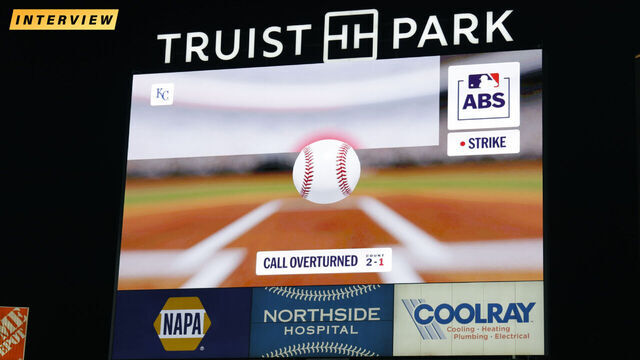
TORONTO - When Tyler Glasnow first encountered the ABS challenge system during a minor league rehab assignment in 2024, he knew baseball had something great.
Now, two seasons later, the Los Angeles Dodgers right-hander is thrilled that the technology has finally made its way to Major League Baseball.
"It's entertaining for fans, and I think it just gives us the true result," Glasnow told theScore. "It just seems like a win-win situation for everybody."
Just two weeks into the ABS challenge system era, it's hard to believe we went so long without it. Aside from the pitch clock, the challenge system might be the most impactful rule change in the game over the last 40 years.
One of the system's key strengths is that everyone involved is operating on a level playing field. The strike zone has no bias toward pitcher, batter, catcher, or umpire. The only thing that matters is getting the call correct. If a player feels like the umpire made a mistake, they can do something about it now.
That control over their own fate has been a major selling point for the players.
"You feel like you have the power to override (bad calls)," Toronto Blue Jays outfielder George Springer told theScore. "I actually think the umpires are good. They get a lot of stuff right. I just think every hitter always wants control of his at-bats from start to finish. To feel that you have that control is obviously great, but there's a strategy about when you want to do it."
Tracking how teams are using their challenges has become one of the more fun elements of the season. We've seen some clubs challenge pitches in the first at-bat of the game, while others save them for the most high-leverage situations. Poor decisions have burned both veterans and rookies, and a team's ability to adjust to this new reality will have real consequences on the game results throughout the season.
"The situation's going to dictate it," said Springer, who's 1-0 in challenging pitches. "I think the ones where I know 100% it's a ball, I think it's a good time to do it. There was one in the first inning that, in my mind, I knew was a strike, but it was one of those where maybe later on in the game you challenge just to see what happens.
"I went and looked at it on the ABS in the dugout, and a lace had hit the zone - it's a strike. So for me, that was a good no challenge in that spot."
Different clubs have certain philosophies. Blue Jays manager John Schneider said heading into the season that he didn't want his pitchers to challenge calls, joking that they're too emotional. Instead, he's leaving things in the hands of his hitters and catchers.
As of Thursday, Toronto's been one of the worst teams at challenging calls, going 4-for-11 over its first 12 games.
For the most part, pitchers across the league have removed themselves from the equation when it comes to challenging pitches.
Entering play Thursday, only 14 pitchers had challenged calls, with the group going 7-for-14. Compare that to 60 different catchers and 190 hitters challenging. Notably, fielders have been significantly better than hitters early on.
"I trust Will (Smith)," Glasnow said of his starting catcher. "There are some times where I think it's a strike and go back in the dugout and look, and it's not. Knowing my eyes versus the true zone, I'm was just like, whatever. I just trust (Will), and he's great at it, too."
"As a catcher, you kind of see it more for what it is," Rockies backstop Hunter Goodman told theScore. "I think pitchers can get emotional with it. These guys are throwing high 90s, 100 all the time, so how well are they actually seeing where the pitch is going? I think the catcher has a much better chance at (winning challenges)."
As disgruntled as fans can get at times with umpires, the consensus in baseball has always been that the calls over the course of the game often balance out. But what the challenge system is exposing is just how much a single missed call can alter an entire game.
One recent example came Wednesday, when the Boston Red Sox led the Milwaukee Brewers 3-0 in the seventh inning. With two outs and the count full, umpire Brennan Miller called a fourth ball on Greg Weisert's pitch, appearing to load the bases for the Brewers. However, catcher Carlos Narvaez challenged the call, and it was overturned to a third strike, ending the inning and extinguishing the threat.
That one pitch dramatically altered the game, and the challenge took all of 10 seconds to resolve, immediately eliminating any controversy. The Red Sox went on to win 5-0, with the overturned call shaping the late innings and influencing pitcher deployment. It's amazing just how much getting the call right can change so much.
ABS is also showing that the biggest pitches aren't always the ones that end a plate appearance. Glasnow noted that potentially flipping a 2-1 count into a 2-2 as opposed to 3-1 can give pitchers an incredible advantage over a hitter.
"Even the difference between 2-1 and 1-2 is huge," Springer said. "I think you can always go back to an at-bat at some point in the game, the week, the month, the year, and say, 'You know, if that call had just gone my way, you never know what would have happened.' So I think guys are very aware of that."
Now, with the ABS challenge system, we can see those potential what-ifs turned into realized outcomes.
Additionally, giving each team two challenges per game has helped eliminate so many of the really bad calls without slowing down the pace. Unlike lengthy replay reviews for plays on the bases, the challenge system is quicker, empowers players, and delivers clear, definitive rulings. There's no ambiguity - it's either a strike or it isn't.
While the ABS challenge system has exposed some umpires' struggles to call a game, it has also highlighted the impressive skill of so many others.
With a system in place to track umpire accuracy, it should not only breed greater accountability but also demonstrate why we don't need a fully automated zone. Umpires and catcher framing still have a place in baseball.
"I don't think anybody's gonna challenge to be disrespectful," Springer said of the thought of showing up umpires. "Guys are competing. As we've seen, there's been a lot of calls that have been right."
And though umpires are under more scrutiny than ever, Glasnow pointed out that the ABS challenge system can benefit them, too.
"It gives the umpire a nice little, 'Yeah, sit there and talk shit (about a call). If you have challenges left, use them,'" Glasnow said.
Just two weeks into another one of baseball's new realities, and it's already clear: the ABS challenge system is a resounding success that's making baseball better.