Second-last stop: Mexico's core is approaching the end of the line
Among the 23 footballers summoned to Mexico's squad for the Confederations Cup are seven players who represented El Tri at the 2010 World Cup. There's Guillermo Ochoa, the curly-haired 'keeper who never seems to be at the right club at the right time. There's Rafa Marquez, the captain who defies the test of time. There's Hector Moreno, the defender who dreamed of being a singer as a child. There's Andres Guardado, the holding midfielder who is as consistent as he is intelligent. There's Giovani Dos Santos, the older brother. There's Javier Hernandez, the country's all-time leading scorer with a baby face. And there's Carlos Vela, the forward whose relationship with the national team is wayward.
The average age of the seven footballers is over 30, and Marquez is the oldest of the septet at 38. Alfredo Talavera and Oribe Peralta, 34 years old and 33 years old, respectively, were also called up for the Confederations Cup, and have been staples of Mexico's squad since the beginning of the decade.
They are the faces of a generation that rode, and is still riding, a roller coaster. They went through the embarrassment that was qualifying for the 2014 World Cup, and the agony of the #NoEraPenal. They experienced the glory of beating the United States of America in the final of the Gold Cup, and the humiliation of Mexican football's darkest night, when Chile scored seven goals against El Tri at the Copa America Centenario. For many Mexicans, it's a crop of footballers who never lived up the hype.
The sand is almost done flowing through the hourglass, but there's still time for the generation to leave its mark. The Confederations Cup presents El Tri with a wonderful chance to win a major tournament beyond the Gold Cup, and, of course, there's the 2018 World Cup. In other words, there are two remaining opportunities.
Winning the Confederations Cup wouldn't be historic by Mexico's standards. El Tri won the tournament on home soil in 1999, vanquishing Brazil in the final in front of more than 110,000 supporters at Estadio Azteca. Marquez, then just 20 years old, played in all of the national team's games.
Furthermore, by no means does success in the Confederations Cup suddenly change the generation's place in history. Mexico could win the tournament, but it would all be for nothing if the national team was to collapse spectacularly at the 2018 World Cup. Any disaster on football's biggest stage would cement its status as a perennial underachiever.
Nonetheless, the Confederations Cup can cast a shadow over the generation's history of mortification, bad luck, and seven-goal abuses. It can make sure that the likes of Ochoa, Marquez, Moreno, Guardado, Dos Santos, Hernandez, and Vela are remembered in a positive light when it comes to international football.
Just ask Cuauhtemoc Blanco about the power of the Confederations Cup. He scored Mexico's fourth goal in El Tri's 4-3 victory over Brazil in 1999. Of his 39 international goals, few, if any, are as iconic as the one where he collected the ball from Marquez, turned Odvan inside out, and slotted the ball past Dida with his left foot at the Azteca.
In a tournament where Ronaldinho scored his first-ever international hat-trick, it's Blanco's name which is remembered.
"With that goal we wanted to get forward as quickly as possible," Marquez said. "I was lucky I crossed the ball so well because it was with my weaker left foot. Blanco did really well and was able to finish. Cuauhtemoc was and is an idol in Mexico. He was a role model for all of us. He showed his qualities at that Confederations Cup."
Marquez added: "I have wonderful memories of the final in the Azteca stadium because it's got a unique atmosphere. When I think back on all the success I've enjoyed throughout my career, winning the Confederations Cup in Mexico is right up there. It's a big deal for any player to win that title. I'll never forget it."
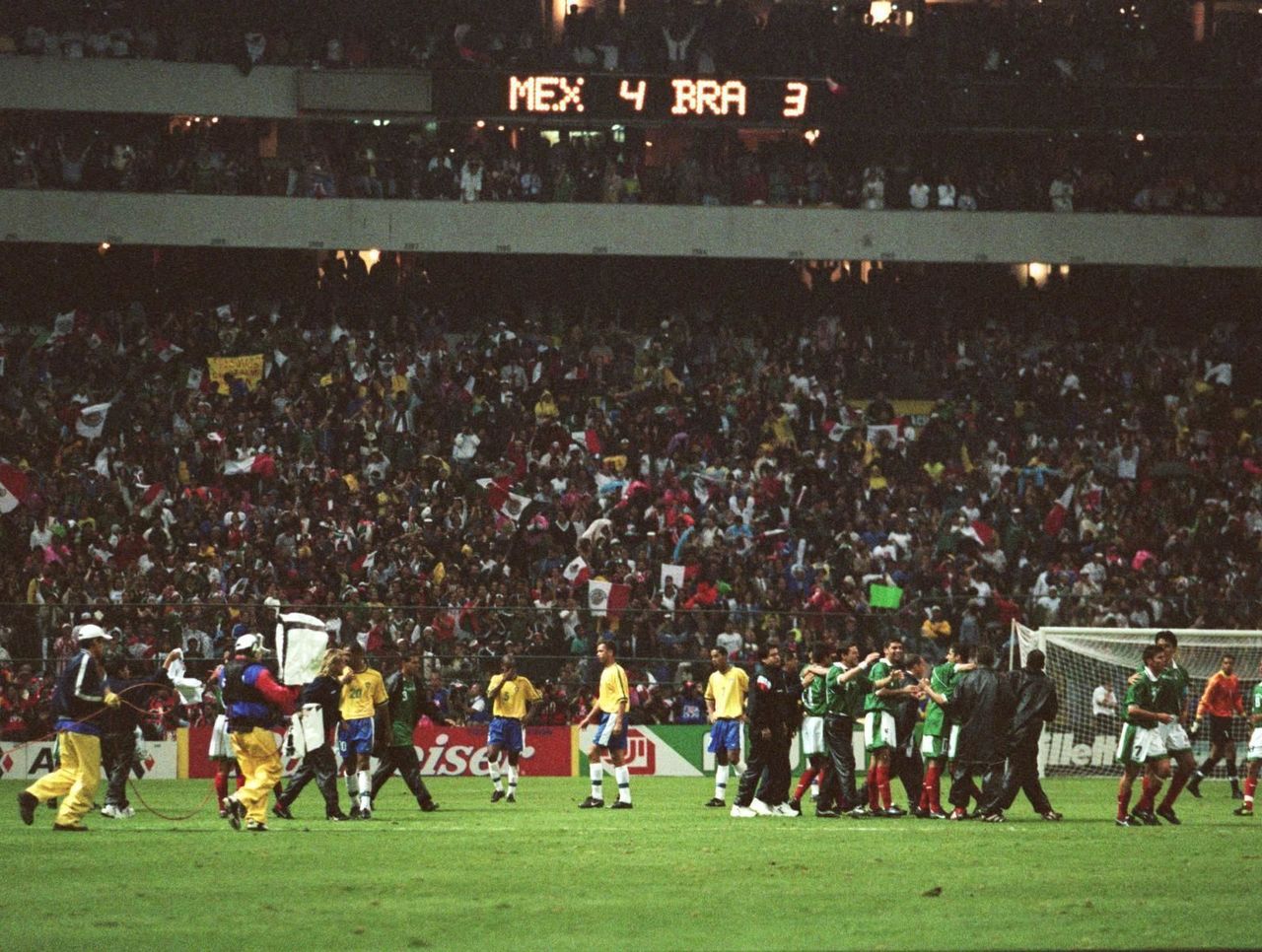
(Photo courtesy: Getty Images)
It's easy to write off the Confederations Cup as an insignificant tournament, a mere tune-up for the World Cup. But a competition is what you make of it, and, for a generation that's running out of time, this one is of particular importance.
The 2018 World Cup will be the last hurrah for Mexico's core. Perhaps some of them will be representing El Tri in 2022 - nobody would be shocked if Marquez was still around - but it will be Diego Reyes, Hirving Lozano, and Jesus Corona who are the nucleus of the national team in four years' time.
If Ochoa, Marquez, Moreno, Guardado, Dos Santos, Hernandez, and Vela are taking Linea 1 of Mexico City's metro from Observatorio to Pantitlan, the Confederations Cup is Zaragoza, the station before they get off.
HEADLINES
- Latest transfer news and rumors: Arsenal, Man City compete for attacker
- FIFA triples price to almost $33K for best available World Cup final tickets
- Rail fare to World Cup final stadium is cut ... to $105
- Mexico threatens World Cup ban for players who don't report to camp
- Tigres beat Nashville again to book Champions Cup final berth